Department of Conservation and Recreation
Conserve. Protect. Enjoy.
Department of Conservation and Recreation



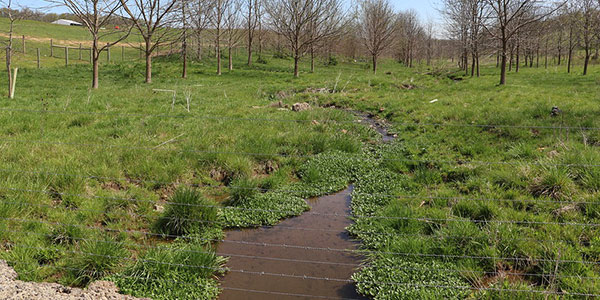
Thousands of farmers have made the Conservation Reserve Enhancement Program (CREP) one of Virginia's most active water quality partnership efforts. The program aims to improve Virginia's water quality and wildlife habitat by offering financial incentives, cost-share and rental payments to farmers who voluntarily restore riparian forest buffers, grass and shrub buffers, and wetlands using CREP-approved best management practices (BMPs).
CREP is an enhancement to the federal Conservation Reserve Program, which was established in 1985 and has enrolled more than 36 million acres nationwide. CREP in Virginia focuses on the installation of riparian buffers to reduce nutrient and sediment pollution in the waters of the commonwealth. Though this is a partnership effort, interested individuals should start by reaching out to their local Farm Service Centers to determine eligibility and sign an application. Find your local Farm Service Center.
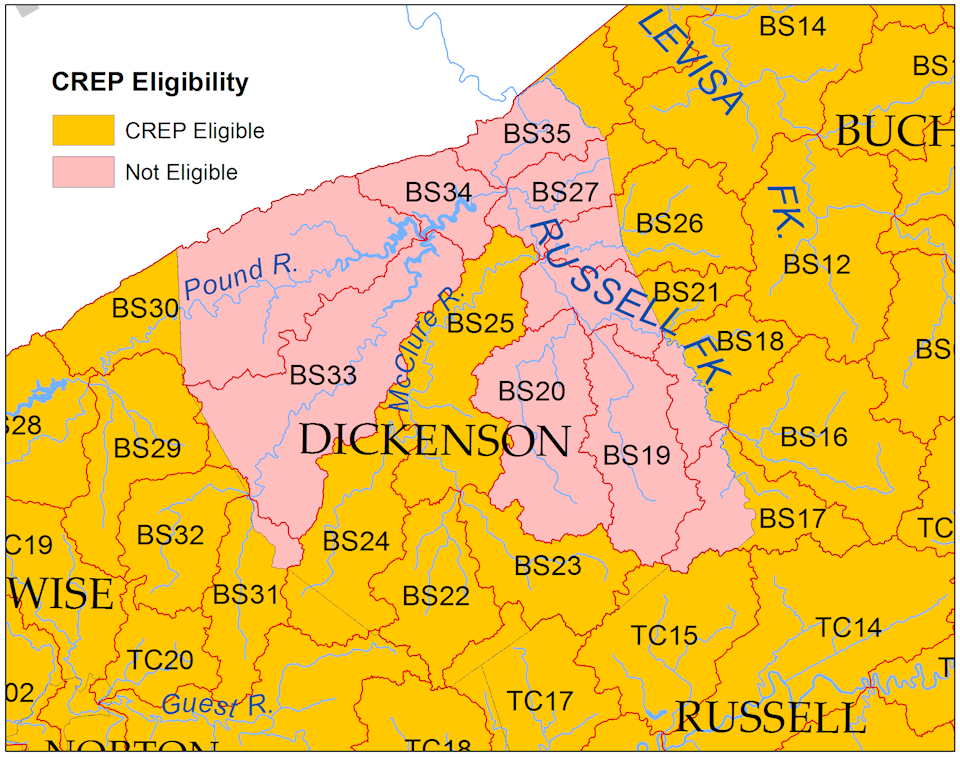
All of Virginia, except for a few portions of hydrologic units in Dickenson County, are now eligible for CREP. However, Virginia CREP is divided into two regions. The Chesapeake Bay CREP targets Virginia's entire bay watershed and calls for the planting of 22,000 acres of riparian buffers and 3,000 acres of wetland restoration. The Southern Rivers CREP targets watersheds outside the bay drainage basin and will establish 13,500 acres of riparian buffers along with 1,500 acres of wetland restoration.
Statewide, these efforts are expected to reduce annual nitrogen loads to waterways by more than 500,000 pounds, phosphorus by more than 66,000 pounds and sediment by more than 33,000 tons. The anticipated reductions will help Virginia meet water quality improvement goals, particularly in the Chesapeake Bay drainage basin.
The CREP program's rental and cost-share payments will help farmers restore riparian forest buffers, grass and shrub buffers and wetlands. All CREP-enrolled pasture or cropland will be planted to hardwood trees, native warm season grasses, or approved shrubs and grasses.
The program also funds restoration of wetlands, forested riparian buffers up to 300 feet wide and cropland buffers up to 100 feet wide.
A 100-foot wide strip of forest and grass can reduce sediment by 97 percent, nitrogen by 80 percent and phosphorus by 77 percent. The Southern Rivers CREP, in particular, also provides for critical habitat for the Northern bobwhite quail, whose population has dramatically declined in recent years.
Federal reimbursement is made through the Farm Service Agency (FSA) for up to 50% of a participant's eligible expenses for implementing best management practices (BMP), such as fencing or alternative watering systems.
State cost-share payments are administered through local soil and water conservation district (SWCD) offices. The state will reimburse up to 35% of restored buffer or wetland of conservation practice costs deemed eligible by the local Farm Service office. Thus, total CREP cost-share now equals 85% of eligible costs. There's also a variety of federal bonus payments, plus a 25% state income tax credit for out-of-pocket expenses, thus further reducing the landowner's cost.
First, the landowner visits the nearest Farm Service Center to initiate the CREP application process. If FSA determines that the land is eligible, a Natural Resources Conservation Service (NRCS) conservationist and local SWCD staff will visit the site with the landowner to determine and design appropriate conservation practices. FSA measures the CREP acreage, and CREP farm conservation plans and contracts are written, approved and signed. After that, once the SWCD application is completed, the landowner is eligible for all CREP payments.
Once the landowner finishes installing the BMP and it is certified, the landowner submits bills for cost-share to FSA. FSA and the local SWCD make the cost-share payments. The SWCD also pays out the state's one-time, lump-sum rental payment. FSA conducts random spot checks throughout the life of the contract and continues to pay annual rent throughout the contract period.
Please send questions about the Conservation Reserve Enhancement Program to the Agricultural Incentives Program Manager at sara.bottenfield@dcr.virginia.gov.