Open fires are prohibited throughout the park from midnight to 4 p.m., Feb. 15 through April 30. Learn more.
Camping and campgrounds
SEARCH BY AMENITIESFew activities bring you closer to nature—and to your family—like camping. It’s the perfect escape from the hustle and bustle of everyday life. Imagine waking up surrounded by towering trees, breathing in fresh air and spending your days swimming, hiking, canoeing or tubing. At night, you’ll gaze at a sky filled with countless stars you’d never see in the city. And after all that adventure, you’re sure to work up an appetite! Get ready to cook delicious meals over the campfire, and don’t forget the s’mores fixings for a sweet ending to your day.
*Please note: Some Virginia State Parks will undergo campground renovations beginning fall 2024. Due to the magnitude of these projects, dates are subject to change, and guests should check the park’s webpage before their visit. See below.
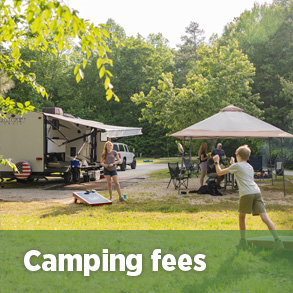
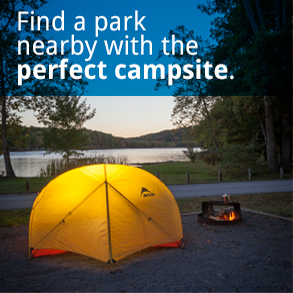
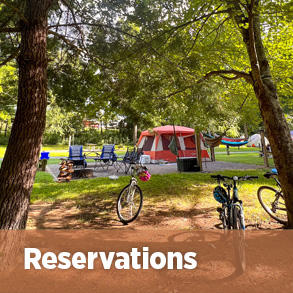
Camping is also a great way to learn outdoor skills, such as safely building a fire or using a compass. It's primal, quiet, healthy, affordable and pet-friendly.
Twenty-nine state parks throughout the state offer camping (see camping rates) with a total of more than 1,800 campsites. Site sizes, configurations and amenities vary. Some parks provide sites with electric and water hookups, which tend to be larger to accommodate recreational vehicles and campers.
- Kiptopeke and Hungry Mother campgrounds offer sewer hook-ups.
- Primitive campgrounds are open year-round and do not offer a bathhouse. See more on camping in the winter.
- Full-service campgrounds (with bathhouses) are open from the first Friday in March through the first Monday in December with the exception of Douthat, Hungry Mother, Pocahontas and Shenandoah River state parks which have full-service campgrounds open year-round.
- Park campgrounds are pet-friendly, (False Cape has some restrictions).
- Earn point toward free nights with the Customer Loyalty Program
- Parks with RV accommodations
- Camping with kids
Reservations
Reservations are recommended, and it's best to reserve a site as early as possible. Reservations are accepted 11 months in advance and up to 2 p.m. on the day of arrival. You may reserve a site online or by calling the Customer Service Center Sunday through Thursday, 7 a.m. to 7 p.m. and Friday and Saturday, 7 a.m. to 9 p.m. All campsites are reserved by the specific site. Payment in full is required at the time of reservation.
If you have concerns or questions about your upcoming reservation, please call our Customer Service Center at 800-933-7275, Sunday through Thursday, 7 a.m. to 7 p.m. and Friday and Saturday, 7 a.m. to 9 p.m. Please be sure to call before your reservation is scheduled to start.
Camping cancellations and transfers
Cancel or transfer your reservation online up until 11:59 p.m. on the day before your arrival or by calling the Customer Service Center during operating hours or online up until 11:59 p.m. on the day before your arrival. There's no charge for transferring a reservation to another date or park. There's a $10 fee to cancel a camping reservation and a $30 fee to cancel a group site reservation (sites designed for seven or more people). If you cancel a reservation on the day of arrival, you will receive a refund minus one night’s fee. Transferring from a group site to a non-group site requires cancellation (including penalty fees) and rebooking.
Early departures
If you choose to leave before the end of your reservation period, we'll refund the unused portion of the stay less one night's fees. Check-out time is used to determine the unused portion. Those canceling stays of two or fewer days will receive no refund after the 4 p.m. check-in time has passed.
Camping details
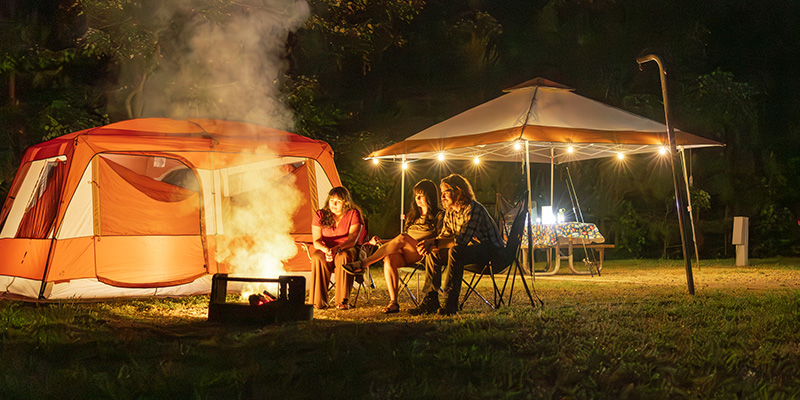
- All equipment must remain within the confines of the campsite without impacting the natural vegetation.
- Campsites can accommodate six people per site or all members of a household.
- Designated group camping areas and sites are available, but all parks can accommodate groups.
- Developed campsites have picnic tables, grills and access to bathhouses. Many sites offer electric and water hookups; those that do not are referred to as “standard.”
- Primitive campsites generally have fire grills, picnic tables, pit toilets and non-potable water. Primitive hike-in camping is available at False Cape and Sky Meadows. Primitive drive-in camping is available at James River, and hike-in and canoe-in sites are available at Belle Isle, Caledon, New River Trail and Powhatan state parks.
- Some parks have equestrian campsites with horse stalls.
Find a list of those facilities here. - The maximum camping period is 14 days in a 30-day period. While campers cannot be assured of access to their reserved sites before the reservation start time of 4 p.m., arrive early to avoid lines at check-in and enjoy the park until your site is ready. Check-out is 1 p.m.
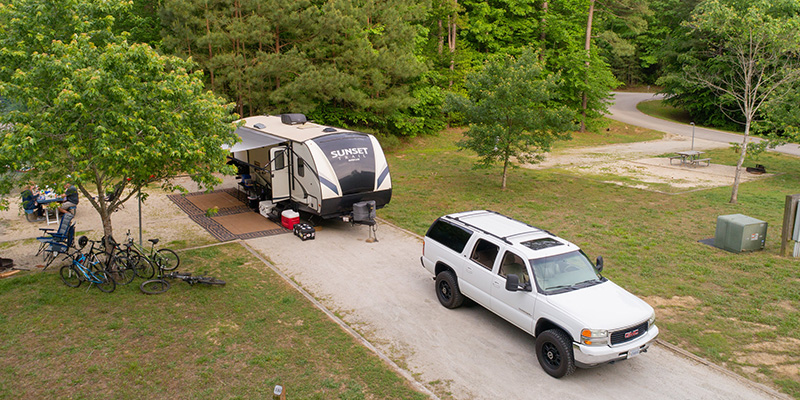
Vehicles and camping units: Unless otherwise specified, up to two camping units are allowed per campsite; only one axled camper is allowed per site. In designated high-impact areas, all camping units, equipment and vehicles must be within the defined area's borders. With few exceptions, campsites accommodate only up to a given maximum equipment size. All equipment smaller than that maximum is allowed on that site type. Large sites are not restricted to only RVs, but campers should be aware that parks have few large sites so campers should select an appropriately sized site.
See campgrounds with RV sites.
Hammock camping is allowed in developed and primitive sites, though it varies from park to park due to campsite logistics (i.e. trees not near enough or large enough, etc.). Hammock campers are required to use 1” wide minimum attachment straps, set-up only on trees larger than 12” diameter or 37” circumference; approximately 4’ off the ground. Hammock campers should check with park staff to ensure that they are directed toward a hammock friendly campsite. Hammocks should only be set-up within a reasonable distance from the reserved campsite and must not encroach upon other campsites. Hammocks that are free-standing must be set-up within the designated site borders.
Quiet time: Loud music and other noise and disturbance that can be heard beyond the campsite are prohibited during quiet hours, from 10 p.m. to 6 a.m., at all parks. Generators are not allowed in campgrounds.
Note: False Cape State Park does not allow motor vehicles and is accessible only by tram (campers may not use the tram), foot, bicycle or boat. False Cape is reached by land via a six-mile path through Back Bay National Wildlife Refuge. Between Nov. 1 and March 31 access through the refuge is restricted to the beach. High tides and soft sands make hiking and bicycling extremely difficult. Reservations are required for False Cape State Park and a refuge fee may be charged. Read A Beginner's Guide to Hiking and Biking to False Cape State Park.
Find information about Virginia's private campgrounds here.

Camping cabins, yurts and camping lodges
Some parks offer alternate camping facilities. Guests renting these facilities, which are in campgrounds, use the campground's bathhouse. These facilities fall under the same transfer policy as that for cabins.
Camping cabins are generally one-room wooden buildings with two sets of bunk beds, a table, a ceiling fan and an electrical outlet. They have no heating or air conditioning. Guests use nearby bathhouses' rest rooms and showers. The camping cabins have a picnic table and a fire ring, grill or both. Guests must bring their sheets, pillows and towels. A minimum two-night stay is required for camping cabins. Check-in is 4 p.m. and check-out is 10 a.m.
Camping cabins are available at:
- Lake Anna
- Pocahontas
- Shenandoah River
- Westmoreland (Westmoreland camping cabins have two small rooms with two single beds in each room)
Check for details on the given park’s web page under Cabins, camping.
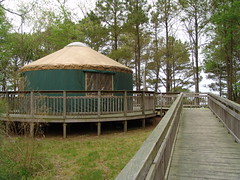
Recreational yurts are a modern adaptation of an ancient nomadic shelter that combines a beautiful wood frame and with durable, electronically bonded architectural fabric. It's a cross between a tent and a cabin. Although maximum occupancy is four, yurts have beds for only three (a queen, a twin and a trundle pull-out). Linens are not provided so guests must bring their own as well as towels and sleeping bags. Each yurt has a large wooden deck with patio tables, a picnic table and a fire-ring with cooking grate. Yurts have no electricity, heat, air conditioning or on-site water. Check-in is 4 p.m.; check-out is 10 a.m. A two-night minimum stay is required if Friday or Saturday night is included, one night otherwise.
Kiptopeke State Park has the system's only "deluxe" yurt. It offers a spectacular view of the Chesapeake Bay, has a large wooden deck, picnic table, fire ring with cooking grate, exterior floodlight, food preparation table and water spigot. Smoking, cooking and pets are not allowed in the yurt. It has electricity and air conditioning and sleeps six; guests must bring sheets, blankets, towels and pillows. Check in is at 4 p.m. and checkout is 10 a.m. From Memorial Day to Labor Day, a week-long stay is required, and a two-night minimum stay is required otherwise. As with park cabins, the week-long stay requirement is reduced to four nights three months of arrival and two nights within a month of arrival.
Learn more about yurts.
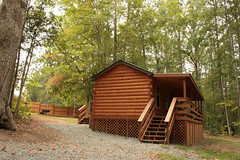
A few parks have camping lodges (bunkhouses). These two- or three-room pre-fab buildings have seven bunk beds, and each lodge accommodates up to 14. Check in is 4 p.m. and check out is 10 a.m. Guests must bring sleeping bags or sheets, blankets, towels and pillows. There is a two-night minimum stay. Because these facilities are also used to house volunteers, unlike other overnight dwellings they are unavailable for rent 11 months in advance.
Camping lodges are available at:
- Bear Creek
- Belle Isle
- Claytor Lake
- Fairy Stone
- Grayson Highlands
- Holliday Lake
- James River
- Kiptopeke
- Occoneechee
- Smith Mountain Lake
- Staunton River
Amenities vary by park so please see the given park’s Camping, cabin section for details.
Know before you go: Camping safety tips
- Stay up-to-date with the weather.
- Review all reservation materials for important emergency related information.
- Know which county you're staying in to know which weather alerts apply to you.
- Heavy rainfall can cause flash flooding. Use caution when hiking or camping near streams and rivers.
- When thunder roars, go indoors! If you hear thunder or see lightning, go immediately to an enclosed building or hard-topped vehicle.
Parks with camping
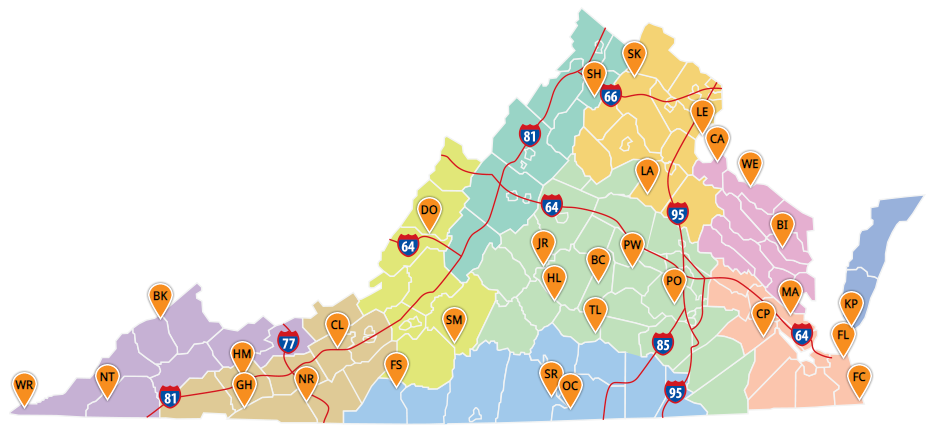
* Here is the park that is affected by the renovations:
- Grayson Highlands State Park - Hickory Ridge Campground is expected to reopen May 15, 2026, however, dates are subject to change.
Recent blogs about Camping and Winter Camping
- 5 must-do activities at New River Trail State Park
- 5 things to experience at Bear Creek Lake State Park
- Bikepacking New River Trail State Park: Q&A with Misty Prewitt
- 6 Ways to Enjoy Great Camping in the Best Parks on the MidAtlantic
- Winter activities at Powhatan State Park
- 10 ways to take on the Trail Quest challenge
- Spring Burning Restrictions February 15 through April 30
- More recent blogs about Camping, Winter Camping.
Find a Job at
Virginia State Parks

Order your Virginia State Parks
license plate