Department of Conservation and Recreation
Conserve. Protect. Enjoy.
Department of Conservation and Recreation



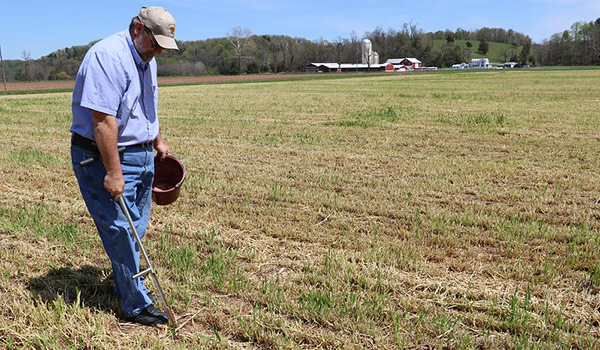
DCR’s Nutrient Management Program addresses nutrient applications to both urban landscapes and agricultural operations in nutrient management plans. Nutrients found in fertilizers, manure, biosolids and other nutrient sources are managed in ways that protect groundwater and surface water from excessive nutrient enrichment.
Nutrient Management Plans improve and protect water quality using best management practices such as timing, rate and placement of fertilizer, manure and biosolids for agricultural and urban purposes.
DCR administers the Nutrient Management Training and Certification Program established by Virginia Administrative Code. Training and Certification Regulations stipulate requirements for certification of private and public sector planners and criteria for nutrient management plan content and procedures. DCR conducts training sessions and examinations every six months. Private and public sector planners include independent ag and lawn care consultants, agronomic staff of ag and turf supply companies, industry field representatives, soil and water conservation district staff and Natural Resources Conservation Service staff to name a few categories of employment that support nutrient management. The Certification and Training program also oversees continuing education training for recertification of nutrient management planners. There are more than 400 certified nutrient management planners in Virginia.
View a list of available training school courses, exam announcements and continuing education meetings.
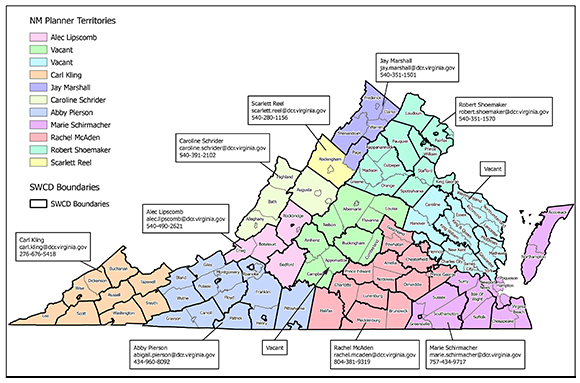
DCR’s direct support of the Nutrient Management program is through our Nutrient management specialists in our regional offices located throughout the Commonwealth. Our specialists write nutrient management plans in their service regions when requested by farmers. In addition to writing plans, specialists to help farmers with manure testing, calibration of nutrient application equipment and coordinate soil nitrate testing in agricultural crop fields. Click the map below.
Nutrient management staff and specialists teach farmers and urban land managers about nutrient management practices through demonstration field days, industry meetings and individual contacts. DCR also develops educational materials, such as brochures promoting the benefits of nutrient management planning and best management planning, for farmers and urban land managers.
Our administrative staff works with state universities to develop management procedures capable of maximizing efficient nutrient use and minimizing losses to ground and surface waters. For example, the development of a soil nitrate test for corn resulted in reduced nitrogen use by an average of 46 pounds per acre on fields where the test was used. DCR also uses satellite-based global positioning system data to better account for farmers' efforts to curb nutrient and sediment loss from their operations.
Nutrient Management Specialists assist DCR's Chesapeake Bay Local Assistance staff and soil and water conservation districts in the preparation of Bay Preservation Act plans. These plans address soil erosion, nutrient management and integrated pest management on farms within Bay Preservation Areas as defined by Chesapeake Bay Preservation Area Designation and Management Regulations.
DCR staff also collaborate with other state agencies and localities to improve and protect water quality. Our Animal Waste Coordinator approves nutrient management plans for permitted animal operations, and our Biosolids Coordinator approves nutrient management plans written for land application of biosolids. Nutrient management specialists provide plan writing assistance and support to approximately 20 counties that have zoning ordinances requiring nutrient management plans for confined livestock operations.
DCR and the Virginia Poultry Federation now offer a poultry litter transport incentive program to facilitate the efficient use of poultry litter as a crop nutrient source in areas that most benefit from those nutrients. The aim is to encourage the development of self-sustaining poultry litter markets in areas outside the Chesapeake Bay watershed. Learn more about the program.
Virginia has an innovative tax credit program for the purchase of satellite-guided farm nutrient and pesticide application equipment for “prescriptive” placement of these materials. Recipients of the 25% tax credit must purchase equipment meeting state specifications and develop a nutrient management plan for their farm operations. The administration of this program is a collaborative effort with the Soil and Water Conservation Districts. Learn More.