Department of Conservation and Recreation Department of Conservation and Recreation

Conserve. Protect. Enjoy.
DCR Logo
Mobile Menu
Search DCR Site
Facebook Twitter YouTube Instagram LinkedIn
About DCR
 
State Parks
 
Natural
Heritage
Soil and Water
Conservation
Recreation
Planning
Dam Safety and
Floodplains
Land
Conservation
  • Natural Heritage
  • About Natural Heritage
    • Overview, Mission
    • Natural Heritage Inventory
    • Community Ecology Program
    • Healthy Waters Program
    • Information Management
    • Environmental Review
    • Natural Area Protection
    • Stewardship
    • Staff
    • Internships
  • Natural Area Preserves
    • Public Access Guide (PDF)
    • Special Events and Hunting
    • Natural Area Research
  • Rare Species and Natural Communities
    • Rare Species and Natural Community Search
    • Rare Species and Natural Community Lists
    • Rare Species Sighting Form
    • Natural Communities of Virginia
    • Locality Summary Maps
    • Rare Butterfly and Dragonfly Atlas
  • Information Services
    • Info Services Order Form
    • Locality Assistance Program
    • NH Data Explorer
    • Species and Community Search
    • ConservationVision and Green Infrastructure
    • Telecommunication Towers (PDF)
    • Conservation Lands Database
    • Wetlands Catalog
    • Species Habitat Modeling
  • Pollinator Smart Solar Site Portal
    • Comprehensive Manual (PDF)
    • Scorecard Templates
    • Virginia Native Plant Finder
  • Native Plants
    • Benefits
    • Natives vs. Aliens
    • Buying and Growing
    • Virginia's Physiographic Provinces
    • Native Plant Finder
    • Flora of Virginia
    • Policy 151 - Plantings on Department Lands
  • Invasive Plants
    • Invasive Plant List
    • What You Can Do
    • Factsheets
    • Invasive Species Working Group
  • Invertebrates
    • Monarch butterflies
  • Caves/Karst
    • Cave Board
    • Cave and Karst Trail
  • Publications
    • Flora of Virginia
    • Peer Reviewed Papers
    • Enews
    • Brochures and Factsheets
    • NH Plan
Home » Natural Heritage » Healthy Waters Program

Healthy Waters Program

The Virginia Natural Heritage Program, in the Virginia Department of Conservation and Recreation (DCR), is known for the discovery, identification, protection and monitoring of rare biodiversity in Virginia. This biodiversity consists of rare plant and animal species populations, and exemplary natural communities. To address the identification and protection of aquatic communities, DCR-Natural Heritage manages the Healthy Waters Program, in collaboration with Virginia Commonwealth University (VCU) and the Virginia Department of Environmental Quality (VDEQ).

Traditional aquatic assessment programs are classified based on water quality standards with a subsequent restoration plan to improve degraded surface waters. While this is a critical activity to provide the Commonwealth with healthy ecosystems, it is equally as important to seek viable opportunities for best management practices to protect streams that are already considered biologically diverse. There is a direct relationship between land cover, key watershed processes and the ecological health of streams. Moreover, the integrity (health) of aquatic ecosystems (streams) is tightly linked to the watersheds of which they are a part. Therefore, the Healthy Waters program operates from a basic understanding: the conservation and protection of healthy waters today is ecologically and economically prudent, and deserves precedence over expending resources in attempt to restore streams after they have been damaged.

Virginia has more than 300 ecologically healthy streams, creeks and rivers and there are more to be identified. Healthy streams are identified by factors that include: high numbers of native species, a broad diversity of species, few or no non-native species, few generalist species that are tolerant of degraded water quality, high numbers of native predators, migratory species whose presence indicates that river or stream systems are not blocked by dams or other impediments, and low incidence of disease or parasites.

The Healthy Waters Program uses high quality archival data, combined with extensive, new data collected by the VCU stream assessment team, to develop a broad suite of georeferenced databases of aquatic resources. These resources include fish and macroinvertebrate communities, as well as instream and riparian habitat data to provide the basis for community level identification and prioritization of critical resources for protection. Streams in Virginia have been identified and ranked as "outstanding," "healthy", "restoration candidate" or "compromised" through a stream ecological integrity assessment known as the Interactive Stream Assessment Resource (INSTAR). Streams identified as "healthy" or "outstanding" are integrated into the Biotics database at DCR-Natural Heritage as Element Occurrences (EOs) and Stream Conservation Units (SCUs). These data products communicate and provide healthy streams data to local land trusts; non-profit conservation organizations; local, state and federal government agencies; and private sector partners to guide efforts to:

  • Create, maintain, or expand riparian buffers: Vegetative corridors of at least 35' in width buffer streams from activities in the watershed by intercepting runoff that would otherwise transport sediment and other pollutants to the stream. This is one of the most effective measures for protecting streams. However, to achieve protection of steam corridors to maintain and ensure aquatic and terrestrial communities, we recommend forested riparian buffers along the river and any streams on the property. These buffers should be at least 100 feet wide on both sides of the waterways. If slopes are 11-25 % the buffers should be 150 feet wide and if slopes are greater than 25% buffers should be at least 200 feet wide. These buffers should be kept free of livestock and soil disturbances. Timber harvesting of 50% cover of the landward 50 feet these buffers may be acceptable.
  • Protect headwater streams: Often intermittent, and therefore not recognized as a "blue line stream" and underserved by regulation, these streams are extremely important to the natural function of downstream waters and habitat for aquatic communities. Exclusion such as fencing livestock out of these areas can prevent downstream degradation of high quality perennial streams.
  • Maintain natural stream flow to ensure aquatic habitat consistent with healthy ecosystems: The natural, seasonal pattern of stream flow, the stream's response to storm events, and maintaining minimum flow levels may be as critical to a stream's health as water quality.
  • Protect natural stream channels: Stream channels naturally adjust across their floodplain and are continually changing. By protecting riparian corridors, through easements or by excluding livestock from unlimited access to stream channels, direct introduction of some pollution (bacteria) may be minimized as well as reducing the direct impacts to aquatic habitat and the creation of erosion problems.
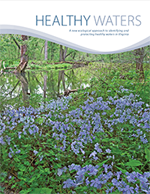
Healthy Waters Program Click here for a complete PDF version of "Healthy Waters - A New Ecological Approach to Identifying and Protecting Healthy Waters in Virginia". To order a copy of the publication by mail, contact Todd Janeski, the Program Manager at todd.janeski@dcr.virginia.gov
Virginia Department of Conservation and Recreation
600 East Main Street, 24th floor | Richmond, VA 23219-2094 | 804-786-6124
Please send website comments to web@dcr.virginia.gov
Address general inquiries to pcmo@dcr.virginia.gov
Copyright © 2025, Virginia IT Agency. All Rights Reserved
Last Modified: Friday, 26 February 2021, 03:20:48 PM
eVA Transparency Reports View the Virginia Department of Conservation and Recreation's expenditures.
Contact Us | Media Center | Privacy Policy | ADA Notice | FOIA | Jobs | Code of Ethics (PDF)
DCR Organizational Chart (PDF) | Strategic Plan (PDF) | Executive Progress Report (PDF) | Public Safety & Law Enforcement