Department of Conservation and Recreation
Conserve. Protect. Enjoy.
Department of Conservation and Recreation



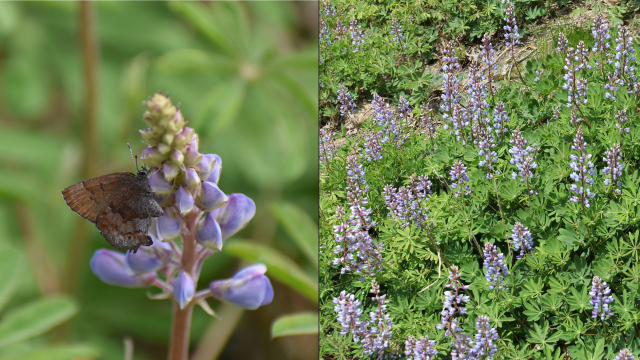 As an experienced birder, Andrew Rapp knows how to show another viewer where to spot an object by describing visual landmarks like a clump of gray sand.
On a sunny morning earlier this spring, he pointed out a dark butterfly whose brownish-gray wings and small profile helped it blend in almost seamlessly as it rested on dark sandy soil, surrounded by tiny green shoots on the side of a road in southeast Virginia.
“We’ll see if we can sneak up a little bit closer,” he said. Mindful of where he was casting his shadow, he slowly crept toward the butterfly, lay flat on his stomach and took a couple of photos with his camera without disturbing it.
Rapp, a field zoologist with the Virginia Natural Heritage Program, was trying to confirm whether frosted elfin (Callophyrs irus) still existed in this state. Once found from Canada to Texas and Florida, frosted elfins have gone extinct in Ontario, Maine and Illinois and are considered critically imperiled in Virginia.
He and other zoologists have been fanning around the state since the spring to continue monitoring populations of at-risk butterflies including frosted elfins, Appalachian grizzled skipper, mottled duskywing and Mitchell’s satyr. The program works to protect and manage habitat for rare species and other natural heritage resources.
The timing of surveys is dictated by the activity of the butterflies or caterpillars. Some may have only one flight season a year, which could be as short as two weeks. The weather conditions have to be just right; some adult butterflies are more active when it’s warmer and not too windy. Some caterpillars may be easier to spot after dark while using black light.
The frosted elfin that he found next to the road seemed to pay no heed to a couple of vehicles that roared through the otherwise still and quiet surroundings. “This one’s not really nectaring or doing anything,” said Rapp, studying it until it flew off.
-3.jpg)
While some butterflies, like the famed monarch butterfly, follow extraordinary migration patterns, others stick more closely to the host plants they have evolved to depend upon.
The frosted elfins in the southeastern part of Virginia prefer sundial lupine (Lupinus perennis), whose lavender flowers (which turn to face the sun) bloom in April and May.
Rapp noted whether various patches of sundial lupine they had previously found seemed to be thriving as he scanned the areas for certain quirks of the flight patterns of butterflies, moths and bees.
He was in the middle of describing a rare native bee that was visiting a patch of lupine when another butterfly that uses it as a host plant interrupted him.
“Oh — here’s a gray hairstreak! That’s perfect — a female, looks like it’s ovipositing on those young stalks of lupine.”
The tally for the day? Two frosted elfins at two separate known locations.
“It is always positive to find frosted elfins due to their rarity in the state,” Rapp said, adding that seeing only one in each spot was not an encouraging sign. “What we see along the side of the road is only a small fragment of habitat that likely continues back into the woods at both sites.” Although the privately owned habitat, which is monitored by DCR with permission, may support more, “we can only base our understanding of the population health on the few that we see.”
Rapp also documented sightings of Carolina roadside skipper (Amblyscirtes carolina) and lace-winged roadside skipper (Amblyscirtes aesculapius), which are on Virginia’s watchlist.
Choosing to plant species native to your region will benefit the butterflies and other insects that rely on those plants for feeding or laying their eggs.
If you find the host plants for rare butterflies, you can report those sightings on iNaturalist.
Categories
Conservation | Land Conservation | Native Plants | Natural Heritage | Nature