Department of Conservation and Recreation
Conserve. Protect. Enjoy.
Department of Conservation and Recreation



Volunteers working to restore a long-neglected urban park in Arlington, Virginia found out – the hard way – that alder trees would not be a natural fit for the area. The eight seedlings they planted there in 2017 did not survive.
But as Bill Browning and other volunteers from the Arlington Regional Master Naturalists prepare to plant new trees and shrubs this spring, they are well-equipped with scientific data to improve their chances for restoring Powhatan Springs Park.
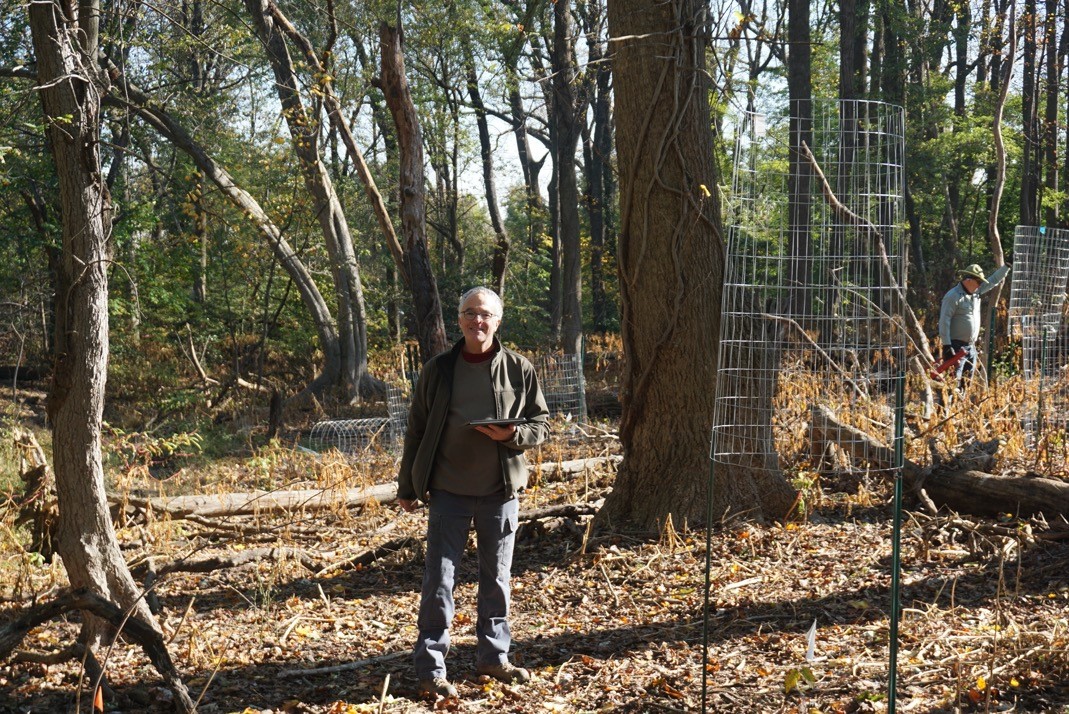 Glenn Tobin, a member of the Arlington Regional Master Naturalists, volunteering to plant trees and shrubs at Powhatan Springs Park. Photo courtesy of Bill Browning.
Since 2020, the group has been relying on information that has painstakingly been observed, documented and classified by experts in the Virginia Natural Heritage Program to select plants that are most likely to thrive at the park. The mission of the program at the Department of Conservation and Recreation is to protect habitats for Virginia’s rare plants and animals, and the best examples of the state’s natural communities.
A natural community is an assemblage of native plants and animals that occurs repeatedly on the landscape under similar ecological conditions. State vegetation ecologists have identified more than 300 natural communities throughout Virginia.
Gary Fleming, a longtime vegetation ecologist who recently retired from the Natural Heritage Division, said volunteers at Powhatan Springs Park and elsewhere are working to get rid of invasive plants and return the land to a natural condition. “They have been able to use our data to first, figure out what natural community probably was there and should be there, and second, what species to encourage while they restore it.”
Nearly a decade ago, the property owned by Arlington County hardly resembled its former natural state. The area next to the Powhatan Springs Skate Park, previously a dairy farm, served as a dumping ground for trash. Thorny, non-native bushes such as multiflora rose (Rosa multiflora) and bush honeysuckles (Lonicera spp.) were taking over the ground. Ivies such as English ivy (Hedera helix) and winter creeper (Euonymus fortunei) were strangling the mature trees above. “It was a mess,” Browning recalled. “It was really hard to walk through the park.”
The site became a volunteer project for Browning, who was eager to put his new training as a Virginia Master Naturalist into practice. Virginia Master Naturalists form a statewide corps of volunteers dedicated to managing natural resources and natural areas in their communities. DCR is a sponsoring agency of the program.
After months of clean-up work, the master naturalists, Boulevard Manor civic association, Boy Scouts and other groups began to see results and began replacing the invasive plants. Although they made sure to choose plants native to Virginia, some disappeared or died almost immediately due to vandalism, deer and drought.
Not being able to watch their hard work bear fruit was disappointing. “I was so frustrated,” Browning said.
As they expanded their strategy to thwart deer, they also researched the natural community data for their area and determined that alders were not commonly found in similar natural communities elsewhere.
Another master naturalist volunteering at the park, Glenn Tobin, even launched a website to share the natural community information with others.
At the Virginia Native Plant Society’s annual native plant symposium on Feb. 12, 2022, the keynote presentation will discuss natural communities.
Natural Heritage vegetation ecologist Karen Patterson said many environmental variables, such as location, soil chemistry, moisture and others, are factors that play a part in how plants fare. For example, she said, a sugar maple tree may only occur at a certain elevation or higher. “Every plant species has a range of habitats where they occur, and then the sweet spot where they do really well.”
At Powhatan Springs, Browning and Tobin hope that the park will be just the right place for the northern red oak that they hope to plant this spring.
Categories
Native Plants | Natural Heritage
Tags
ecosystem