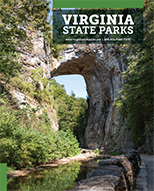
Located about 10 miles north of Lexington, Goshen Pass was the first property acquired by the state to help protect the spectacular views of the 3.7-mile long gorge.
Poor Mountain protects the world's largest population of the globally rare piratebush. The shrub is limited to only a handful of sites.
Bull Run Mountain occupies a series of rocky ridges and steep valleys on Virginia's northern piedmont.
Bethel Beach has sandy beach, low dune and salt marsh habitats. Wind and water create an ever-changing habitat on the narrow beach.
At the mouth of Bush Mill Stream, freshwater meets the saltwater of the Great Wicomico River.
The 316-acre Dameron Marsh is one in a series of protected lands lining the Chesapeake Bay's western and eastern shores.
Hickory Hollow's 254 acres of mixed pine-hardwood forest and ravines form an important habitat for migratory songbirds, wild turkey and a rare plant.
Hughlett Point has several excellent examples of tidal and non-tidal wetlands, as well as exemplary undeveloped beaches, dunes and upland forests.
An isolated point of land jutting into the Chesapeake Bay, New Point Comfort is strategically located along the Atlantic Flyway for migrating birds.
The North Landing River is Virginia's largest. It is almost entirely comprised of wetland communities, five of which are rare in Virginia.
Cumberland Marsh, about 30 miles east of Richmond, is 1,193 acres of freshwater tidal marsh and upland buffer along the Pamunkey River.
Much of Chub Sandhill's vegetation in the region has been lost, but this outstanding woodland remnant supports rare and unusual plants.
Buffalo Mountain is one of the most significant natural areas in Virginia. It boasts 13 rare plants, three rare animals and six significant natural communities.
Towering cliffs, sheer limestone ledges and waterfalls are but a few of the spectacular features of the Pinnacle Natural Area Preserve.
Grassy Hill is a prominent landmark on the west side of the Town of Rocky Mount. The site is characterized by rocky slopes forested with hardwood species and scattered patches of Virginia pine.
This preserve is found on the Bay side of the Eastern Shore. Its 29 acres feature coastal beach, dune, and maritime forest habitats. The preserve provides habitat for the federally threatened northeastern beach tiger beetle.
The vegetation of Virginia is much different from what was found in pre-settlement times. While Virginia's landscape had been mostly forested, there were once open areas where trees were few or sometimes absent.
The area known as False Cape lies just north of the Virginia-North Carolina line and occupies one of the most pristine stretches of coastal habitat in the mid-Atlantic region.
Grafton Ponds represents Virginia's best remaining example of a coastal plain pond complex. The many ponds here were formed by dissolution of the underlying calcareous marine deposits of the Yorktown Formation.
This 298-acre preserve contains outstanding Chesapeake Bay beach, dune, and maritime forest communities, migratory songbird habitat, and an exemplary population of northeastern beach tiger beetles.
Wreck Island is part of Virginia's Atlantic coast barrier island chain. This pristine island preserve consists of beach, dune, maritime grassland/shrubland, salt flat and salt marsh habitats, and is an important nursery for colonial nesting birds.
The Channels NAP is named so because of large sandstone boulders and eroded crevices within this preserve.
Poor Mountain NAP (PM) Bull Run Mountains NAP (BR) Bethel Beach NAP (BB) Bush Mill Stream NAP (BS) Dameron Marsh NAP (DM) Hickory Hollow NAP (HH) Hughlett Point NAP (HP) New Point Comfort NAP (NP) North Landing River NAP (NL) Cumberland Marsh NAP (CM) |
Chub Sandhill NAP (CS) Buffalo Mountain NAP (BM) Pinnacle NAP (PN) Grassy Hill NAP (GH) Cape Charles NAP (CC) Difficult Creek NAP (DC) False Cape NAP (FC) Grafton Ponds NAP (GN) Savage Neck Dunes NAP (SN) Wreck Island NAP (WI) The Channels NAP (TC) |

Click here or on the above
thumbnail to download a
booklet describing Virginia
natural area preserves
with public access.
The Commonwealth of Virginia’s natural area preserves, state forests, state parks and wildlife management areas offer hundreds of miles of trails designed for people to enjoy (or access) the outdoors. These trails offer the public opportunities to experience and enjoy the state’s flora, fauna, cultural resources and scenic beauty. Hiking, angling, boating, hunting, wildlife watching, bicycling and horseback riding are proven contributors to good physical health and mental well-being – part of a healthy lifestyle that reduces illness, obesity and anxiety for all.
Effective March 15, 2011, these trails will be open to wheelchairs, including manual and power wheelchairs, personal mobility assistive scooters and certain other similar devices designed primarily to assist people with disabilities. Users are encouraged to use caution when selecting trails, as many were designed for foot traffic only. Terrain might make them unsuitable for personal mobility devices.
As part of their commitment to making Virginia’s public lands places for all to enjoy, the Virginia Department of Conservation and Recreation, Virginia Department of Forestry, and Virginia Department of Game and Inland Fisheries are also in the process of evaluating safety concerns and the environmental impacts of opening these trails to the use of other power-driven mobility devices by individuals with mobility disabilities. Please check this webpage periodically for updates.