Open fires are prohibited throughout the park from midnight to 4 p.m., Feb. 15 through April 30. Learn more.
Fun Facts
Numbers | Water, water | Vital statistics | What's in a name? | What's so special?
By the numbers
The Virginia Department of Conservation and Recreation manages a diversity of lands:
- 44 state parks
- 3 undeveloped parks
- 68 natural areas
- More than 127,000 total acres; 75,895 acres in state parks
- More than 700 miles of trails
- 301 cabins (located at Bear Creek Lake, Belle Isle, Chippokes, Claytor Lake, Douthat, Fairy Stone, First Landing, Hungry Mother, James River, Lake Anna, Natural Tunnel, Occoneechee, Pocahontas, Shenandoah River, Smith Mountain Lake, Southwest Virginia Museum, Staunton River, Twin Lakes, Westmoreland, Pocahontas)
- 1,938 acres of pollinator habitat
- 27 five and six-bedroom cabins (Bear Creek, Belle Isle, Claytor Lake, Douthat, Fairy Stone, Hungry Mother, James River, Kiptopeke, Lake Anna, Natural Tunnel, Occoneechee, Shenandoah River, Twin Lakes)
- 22 camping cabins
- 50 yurts
- 1,716 campsites
- 7 equestrian campgrounds
- 50 playgrounds
- 30 amphitheaters
- 99 picnic shelters
- 22 visitor centers
- 11 swimming beaches
- 1 swimming pool
- 17 powerboat launches, 13 car-top launches
- 6 fishing piers
- 36 lakes and ponds
- 500 miles of shoreline
- 19 snack bars
- 4 International Dark Sky designations
- More than 100 law enforcement park rangers
State park attendance
- 8.02 million (2023)
- 7.39 million (2022)
- 7.93 million (2021)
- 7.81 million (2020)
- 6.89 million (2019)
Water, water everywhere
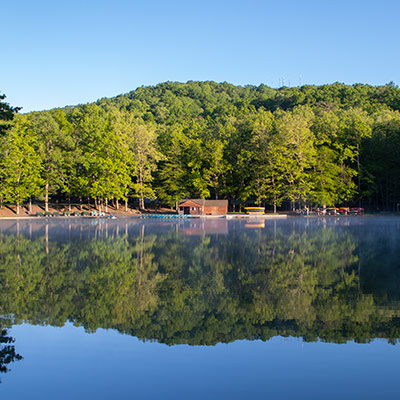
Virginia State Parks have small (50- to 170-acre) man-made lakes at Bear Creek Lake (Cumberland County), Douthat (Clifton Forge), Fairy Stone (Patrick County), Holliday Lake (Appomattox County), Hungry Mother (Marion), Pocahontas (Chesterfield County) and Twin Lakes (Prince Edward County).
Each offers sandy swimming beaches with lifeguards from Memorial Day to Labor Day (no swimming at Swift Creek Lake at Pocahontas) and boat rentals. Gasoline motors are not allowed on these lakes to insure the safety and enjoyment of all those using the lakes. All are regularly stocked by the Department of Wildlife Resources. Guarded swimming beaches are also features of Smith Mountain Lake, Claytor Lake and Lake Anna State Parks. These lakes allow gas-powered boats. First Landing and Kiptopeke have unguarded swimming beaches on the Chesapeake Bay.
Swimming pools
- Pocahontas (Chesterfield County)
- Occoneechee (Mecklenburg County) - Splash Park
State parks offer gas powered boating access to the following bodies of water
- Smith Mountain Lake
- Claytor Lake
- Buggs Island Lake (Occoneechee and Staunton River State Parks)
- Lake Anna
- York River
- Potomac River (Westmoreland and Leesylvania State Parks)
- Chesapeake Bay (Kiptopeke and First Landing State Parks)
- Rappahannock River (Belle Isle)
- James River
Vital statistics
Oldest - Virginia is the only state in the country to have opened an entire state park system at one time. On June 15, 1936, the Virginia State Park system opened to the public with six parks covering 19,000 acres. The six original state parks are:
- Douthat
- First Landing
- Fairy Stone
- Hungry Mother
- Staunton River
- Westmoreland
Newest - Hayfields State Park in Highland County is our newest park at number 44. Culpeper Battlefields State Park in Culpeper County is number 43. Sweet Run State Park in Loudoun County is number 42. Clinch River in Wise and Russell counties is the 41st state park. DCR also has parcels of land under development. They are Mayo River in Patrick and Henry counties and Clinch River is still under development.
Largest - Pocahontas, 7,604 acres
Smallest - Southwest Virginia Museum Historical State Park, 1.5 acres
Highest - Grayson Highlands, 5,084, feet above sea level
Lowest - False Cape State Park, sea level
Most visited - Pocahontas in Chesterfield County
Easternmost - False Cape
Westernmost - Wilderness Road State Park in Lee County is farther west than Wheeling, W. Va., Pittsburgh, Pa., and Canton, Ohio.
Northernmost - Sweet Run State Park in Loudoun County is at the same latitude as Ocean City.
Southernmost - False Cape State Park - southern boundary is the North Carolina state line
What's in a name?
Many state parks are named for the natural resource they feature, like Smith Mountain Lake, Claytor Lake, Natural Tunnel, even Twin Lakes State Park.
But what about names like Douthat, Hungry Mother, Fairy Stone? Here in alphabetical order are some of the more unusual names found in Virginia's State Parks:
Chippokes State Park - Across the James River from Jamestown, this park's name is that of the plantation once there whose land comprises most of the park. The boundaries set in 1619 are still recognized today. The plantation was named for Choupouke, a minor Native American chief who was friendly to the early English settlers.
Douthat State Park - Douthat also has a name rooted in history. In 1795, the Virginia Legislature, under the hand of Governor Robert Brooke, granted a land patent to Robert Douthat for 102,000 acres. Nearly 200 years later, the park is part of that property.
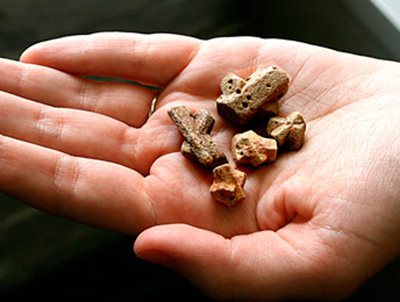
Fairy Stone State Park - Named for the lucky cross-shaped stones found in the park and surrounding area. The stones have their own legend.
- The Fairy Stone Legend: Many hundreds of years before Chief Powhatan's reign, fairies were dancing around a spring of water, playing with naiads and wood nymphs, when an elfin messenger arrived from a city far away. He brought news of the death of Christ. When these creatures of the forest heard the story of the crucifixion, they wept. As their tears fell upon earth, they crystallized to form beautiful crosses. When the fairies disappeared from the enchanted place, the ground about the spring and the adjacent valley was strewn with these mementos of the event. For many years, people held these little crosses in superstitious awe, firm in the belief that they protected the wearer against witchcraft, sickness, accidents and disasters.
Hungry Mother State Park - The only way to explain this one is to tell the legend of Hungry Mother. The legend takes many forms, but the one generally accepted in southwest Virginia has earmarks of truth. The legend has it that when Indians destroyed several settlements on the New River south of the park, Molly Marley and her small child were among the survivors taken to the raiders base north of the park. Molly and her child eventually escaped, wandering throughout the wilderness eating berries. Molly finally collapsed and her child wandered down a creek until she found help. The only words the child could utter were "Hungry Mother." When the search party arrived at the foot of the mountain where she had collapsed, they found Molly dead. Today, that mountain is Molly's Knob and the stream, Hungry Mother Creek. When the park was developed in the 1930s, the creek was dammed to form Hungry Mother Lake.
Kiptopeke State Park - A most appropriate name for this park on the Chesapeake Bay, Kiptopeke is a Native American word for "Big Water." The site was named in honor of the younger brother of a King of the Accawmack Indians who had befriended early settlers in the area.
Occoneechee (pronounced O-ko-nee-chee) State Park - This park is named after an Native American tribe that lived in the area from around 1250 A.D. to the late 1600s. The tribe was forced out of the area in 1676 by the armies of Francis Bacon. The park is located on Buggs Island Lake (Kerr Reservoir).
What's so special about our parks?
How about . . .
Natural Tunnel State Park - Formed a million years ago, Natural Tunnel has been a tourist attraction for more than 100 years. It has been promoted locally as the "Eighth Wonder of the World" since William Jennings Bryant first used the phrase to describe this spectacular formation. Visitors may ride a chairlift down the mountain get close to the tunnel.
Panning for gold at Lake Anna State Park - The state park grounds at Lake Anna are home to a long abandoned gold mine. Each summer the staff at Lake Anna State Park uses soil from the mine and holds panning for gold programs. No one has gotten rich yet - here's the spoiler; all proceeds go to the park - but many have had fun and learned something.
Shot Tower Historical State Park - This stone structure in Wythe County is one of only three shot towers still standing the United States. Molten lead was taken to the top of this 75-foot tower and poured into a shaft that was burrowed an additional 75 feet into the ground where it was collected in a kettle of water. As the lead fell, it solidified into balls of a proper size to use in muskets as shot.
Bald Eagles at Caledon State Park - This site on the Potomac River is one of the most significant summering spots for bald eagles on the East Coast, with more than 60 eagles spotted in the area. It is also one of the only places in Virginia offering eagle tours. Starting in mid-June and running through Labor Day weekend, two tours of the eagle area are conducted each Thursday through Sunday.
Southwest Virginia Museum - This museum chronicles the exploration and development of the Big Stone Gap and surrounding area during the 1890s coal boom, as well as the pioneer period. It is housed in a mansion built in the 1880s by Rufus Ayers, a Virginia attorney general. The museum was acquired by the commonwealth in 1946 from the Slemp Foundation, established by C. Bascom Slemp, private secretary to President Calvin Coolidge and a member of the U. S. Congress.
Sailor's Creek Battlefield Historical State Park – Midway between Petersburg and Appomattox Court House, Sailor’s Creek is the site of the last major battle of the Civil War. April 6, 1865 - the Black Thursday of the Confederacy - Gen. Robert E. Lee's Army of Northern Virginia lost 7,700 men, including eight generals, in the Battle of Little Sailor's Creek. Lee surrendered 72 hours later at Appomattox Court House. The Overton-Hillsman House, used as a field hospital during and after the battle, is open to visitors June through August. The park is also part of Virginia’s Civil War Trails.