
Virginia Department of Conservation and RecreationAn official website of the Commonwealth of Virginia Here's how you knowAn official websiteHere's how you know
 Department of Conservation and Recreation



Model last updated 2020.
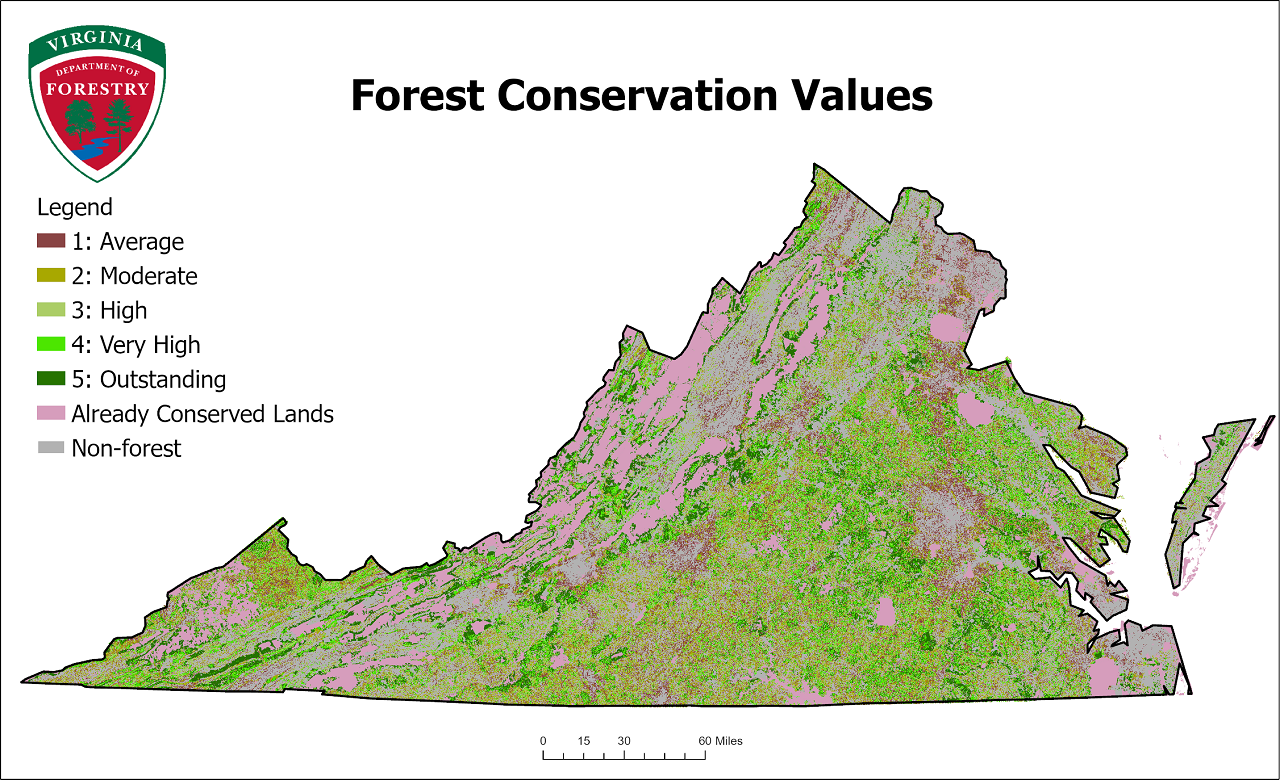
The Forest Conservation Value (FCV) model is a tool designed by the Virginia Department of Forestry (VDOF) to strategically identify the highest priority forestland for conservation in Virginia. The intent is to maximize the efficiency of limited resources by focusing conservation efforts on the highest quality, most productive, and most vulnerable forestland statewide.
The original FCV model was developed in 2013 by the VDOF. Since that time, a number of factors necessitated an update to the 2013 model. The agency has sharpened its focus and priorities through a strategic planning effort completed in 2017. In 2017, VDOF's Forestland Conservation Program implemented a new conservation ranking and prioritization system designed to identify the highest priority projects on a quarterly basis; the FCV is a key component of this ranking system.
The FCV is further intended to contribute to the Virginia ConservationVision, the suite of GIS models maintained by the Virginia Department of Conservation and Recreation (DCR) to inform a cohesive, statewide strategy for land conservation. As this multitude of needs were identified and as new data has become available, VDOF has taken the opportunity to create an up to date, improved FCV model to help inform both internal and statewide conservation efforts throughout the Commonwealth.
The 2018 model applied a completely new approach, with different criteria, methodology, and datasets selected for the analysis than were used in 2013. In 2020 the model was updated again with more recent data for Conserved Lands and SSURGO soils, and with multi-year data from the National Land Cover Dataset (NLCD). The multi-year NLCD allowed development of a more accurate forest cover dataset based on a pattern of productive forest landuse over time rather than the landcover class from a single year. The 2020 model replaces the 2018 version and direct comparison among versions is not recommended.
Model Components
Six data input layers were created based on these components and were ultimately combined to create the final FCV model. The 2020 FCV model evaluates these criteria to prioritize the highest value forestlands for conservation. The model ranks all forestland in Virginia from 1 (lowest) to 5 (highest) FCV. More complete detail on the background for selection, methodology, and limitations of each component is available with the Data Download below.
It is intended to be used by natural resource professionals, conservation practitioners, and local and statewide planners as a tool for planning and prioritization.
For more information, go to: https://dof.virginia.gov/forest-management-health/forestland-conservation/
Page last updated 5/2021.