Department of Conservation and Recreation
Conserve. Protect. Enjoy.
Department of Conservation and Recreation



Virginia State Park overnight facilities have reopened and are once again accepting reservations. For important storm related updates click here.
The Virginia Natural Area Preserve System was established to conserve natural heritage resources. Occasionally, a natural area preserve may be subject to temporary closure to protect sensitive natural heritage resources or to facilitate completion of a resource management activity that benefits natural heritage resources. Natural area preserve closures may apply to the entire site or just a portion of the site, and may last from one day to several months. Public admittance into closed preserves or areas is prohibited during designated closure periods. It is always a good idea to call ahead (check the preserve's web page for the telephone number) to check for any closures before visiting a natural area preserve.
Here are a few reasons why natural area preserves may be subject to closure:
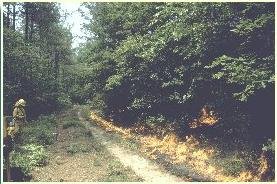 DCR staff conducting a prescribed burn at Chub Sandhill Natural Area Preserve. Because of the
danger to the public from the fire, preserves are closed on burn days.
DCR staff conducting a prescribed burn at Chub Sandhill Natural Area Preserve. Because of the
danger to the public from the fire, preserves are closed on burn days. Prescribed Burning - Many natural heritage resources benefit from fire at some point during their life cycle. Some species even require fire in order to survive. To meet the ecological needs of these fire-adapted natural heritage resources, DCR conducts prescribed burning on some natural area preserves. Prescribed burning is the intentional use of fire in a particular time and place, under defined conditions, to accomplish specific resource management goals. Natural area preserves are closed to public access during prescribed burn operations for safety reasons. Closures for burning usually last only one day but may range up to three days. Because prescribed burning is weather dependent, an exact date of preserve closure cannot be provided in advance, so please call before visiting.
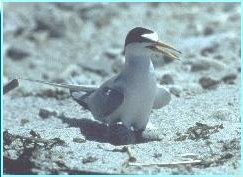 Least Terns, a rare colonial beach nesting bird, nest on some of Virginia's natural area preserves. Parts of natural area preserves containing the colonies of Least
Terns and other beach nesting birds are seasonally closed to protect these sensitive species.
Least Terns, a rare colonial beach nesting bird, nest on some of Virginia's natural area preserves. Parts of natural area preserves containing the colonies of Least
Terns and other beach nesting birds are seasonally closed to protect these sensitive species.
Beach Nesting Bird Colonies - Some rare and sensitive coastal birds nest directly on beaches in large groups or "colonies". The birds are very sensitive to disturbance by people and their pets. When people enter or get too close to beach nesting bird colonies, adult birds will leave their nests, exposing eggs and young to predators and temperature extremes. People may also unknowingly crush the well-camouflaged nests and eggs. Repeated disturbances may cause birds to abandon their nesting site. To protect these sensitive animals, parts of some coastal natural area preserves are seasonally closed to public access. The period of closure may extend from late spring to late summer. Colonies are established in different locations from one year to the next, so the location of the closed area is not always the same year after year.
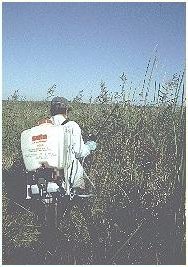 Common reed, a tall
invasive grass found on many coastal natural area preserves, is sprayed by DCR personnel trained and certified in herbicide application. Preserves that require herbicide use may
be temporarily closed to the public during spraying operations.
Common reed, a tall
invasive grass found on many coastal natural area preserves, is sprayed by DCR personnel trained and certified in herbicide application. Preserves that require herbicide use may
be temporarily closed to the public during spraying operations.
Invasive Plant Management - Many natural areas contain invasive plants which compete with rare, native species for resources or which displace rare natural communities. These natural area "weeds" are usually exotic, that is, introduced from other parts of the world. Removed from the natural ecological controls of their native environments, exotic plants may grow unchecked, taking over natural areas as well as farm fields and backyards. Some invasive plants can be controlled only with the use of herbicides. When DCR staff are applying herbicides to combat invasive plants on a natural area preserve, the site may be closed to protect the public from the chemicals in use. Closures for invasive plant management generally occur only during the growing season (March through October) and usually only last for one or two days at a time.