Media Center - News Release
Media inquiries: Please contact Dave Neudeck, dave.neudeck@dcr.virginia.gov, 804-786-5053.
Date: March 15, 2013
Contact: Julie Buchanan, Senior Public Relations and Marketing Specialist, 804-786-2292, julie.buchanan@dcr.virginia.gov
Sales brisk for new flora, buyers not all in Virginia
A feature from the Flora of Virginia Project
By Bland Crowder
EDITORS: Download the flora cover art from
Flickr.
More than half the 3,500 copies of the new "Flora of Virginia" have been sold since the book's publication in November, and a second printing is on the way. The blitz reflects sales from outside Virginia, said J. Christopher Ludwig, co-author of the flora and executive director of the Flora of Virginia Project, which oversaw the book's production.
The 1,600-page flora is a guide to 3,164 plant species native to or naturalized in Virginia. Just six of those species are found solely in the commonwealth. The others range farther afield.
"Because we have the newest flora on the block, other states are finding our manual useful," said Ludwig, who is also chief biologist with the Virginia Department of Conservation and Recreation's Natural Heritage Program, a key partner of the Flora Project.
Lacking a flora for their own state for decades - or centuries - Virginia botanists had to use other floras. The "Manual of the Vascular Flora of the Carolinas," by Albert E. Radford, Harry E. Ahles and C. Ritchie Bell and published in 1968, was a standby, as was the "Flora of West Virginia," by P.D. Strausbaugh and Earl Core, published in 1978. Now Virginia is using its own flora, which has something special to offer botanists in other states, too.
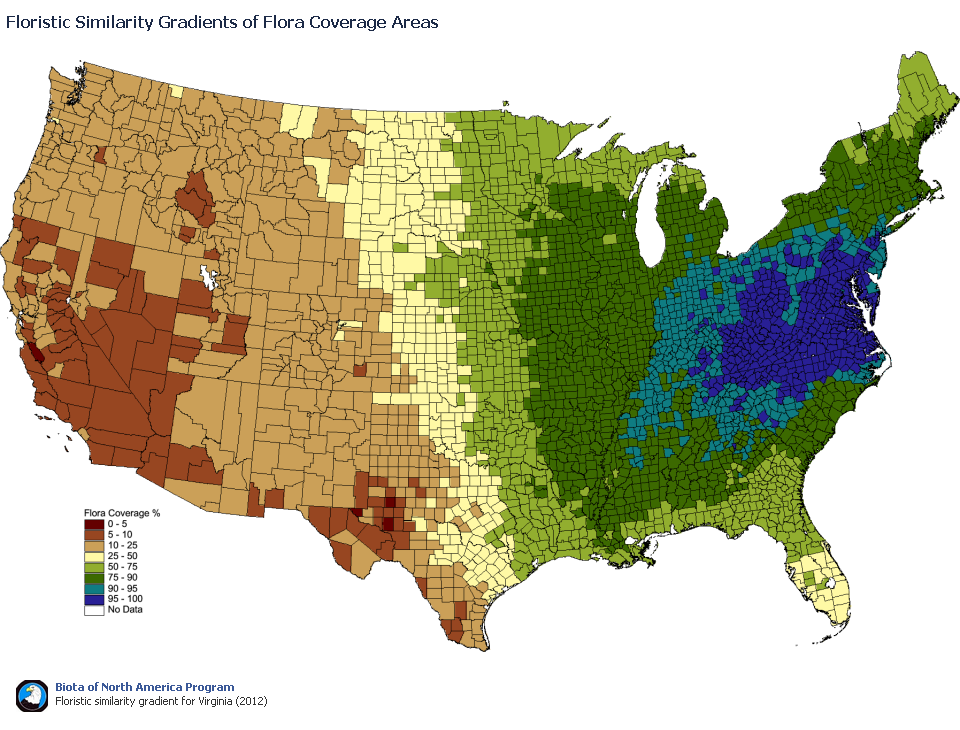
Large chunks of West Virginia, North Carolina and Maryland, however, and parts of Tennessee, Ohio and Pennsylvania, share 95 to 100 percent of Virginia's plants. "A level of 95 percent or more is great," said Alan Weakley, a co-author of the "Flora of Virginia" and curator of the herbarium and an adjunct professor of biology at the University of North Carolina in Chapel Hill. "It means the flora can be used almost as though it actually were intended to cover those areas."
The maps show that most of New Jersey, the remainder of Pennsylvania, West Virginia and Ohio, and most of the rest of North Carolina and Tennessee share 90 to 95 percent of Virginia's plants. "Of course, 90 to 95 percent means that 5 to 10 percent of the species are missing, and that requires some extra attention in using the manual," Weakley said.
One step further, to 75 to 90 percent shared species, reaches the Great Plains, north beyond the Great Lakes, and northeast into lower Maine. The percentages drop further in the Plains and along the warmer Southeast, reflecting different environmental factors and the influx of prairie, southern or subtropical species. "To me, 75 to 90 percent still means it's a very useful reference, but requiring some caution in using it to key plants," Weakley said. "And even at the 50- to 75-percent level, which extends to include the eastern half of the United States, the 'Flora of Virginia' is still relevant, providing valuable new insights on more than half the species found in those areas."
People have taken note of this value of Virginia's new manual. "Indeed, the flora is selling beyond Virginia's borders," said Barney Lipscomb, head of the BRIT Press, of Fort Worth's Botanical Research Institute of Texas, the book's publisher. "We have shipped books to North Carolina, Maryland, Tennessee, Alabama and several other states." The Flora of Virginia Project has mailed copies to Pennsylvania, New Hampshire, West Virginia, Mississippi, New York and Florida, Ludwig said. One copy went to a Virginian now living in New Mexico (whose flora overlaps with Virginia's only 5 to 25 percent). A copy has also gone to England, and another to Sweden.
"The essential purpose of the 'Flora of Virginia' is to enable identification of plants," Ludwig said. "Each species is described in fine detail, and other information is presented, such as flowering and fruiting times, the plant's status in the state, and the characteristics of its habitat." Of the plants described, 1,400 are illustrated with pen-and-ink drawings commissioned for the book. Users are guided through the task of identifying a plant by the flora's keys, which, through a stepwise process, help them winnow down the possibilities.
Special chapters present the history of botanical exploration in Virginia; the processes by which the state's plant communities have developed over geological time; and 50 of the best sites at which to learn about Virginia's plant life.
The flora took 11 years to produce and was made possible by the support of grants, individual donors and five official partners. In addition to the Department of Conservation and Recreation, those partners are the Virginia Native Plant Society, the Virginia Botanical Associates, the Virginia Academy of Science and the Lewis Ginter Botanical Garden.
"We are proud to see this product come to fruition and to have been able to realize it with an eye to conservation," said Tom Smith, director of the Virginia Natural Heritage Program and a member of the Flora Project's board. "The flora is going to be important to botanists, ecologists, planners and environmental consultants in finding, managing, conserving and restoring our native plant communities for generations to come."
It was selected as the official textbook for this spring's plant taxonomy course at James Madison University, and Weakley will use it this fall in his course on plants of North Carolina.
To order a copy of the "Flora of Virginia," visit the home page of the Flora Project's website, floraofvirginia.org, and click the red button. The price is $79.99, plus $6.50 shipping.
Bland Crowder is editor and associate director with the Flora of Virginia Project. He is a freelance writer and editor in Richmond, Va.
Share this news release:


News release archives
2026 | 2025 | 2024 | 2023 | 2022

 Department of Conservation and Recreation