Department of Conservation and Recreation
Conserve. Protect. Enjoy.
Department of Conservation and Recreation



The Virginia Natural Heritage Program updates a list with information on the state’s rarest known native animals four times a year to help identify natural heritage resources in need of conservation.
Staff zoologists conduct surveys throughout the commonwealth for rare species – often coming across other animals that are also being tracked. From a special millipede to a grasshopper that disappears on lichen-covered rocks, here are several highlights from 2025.
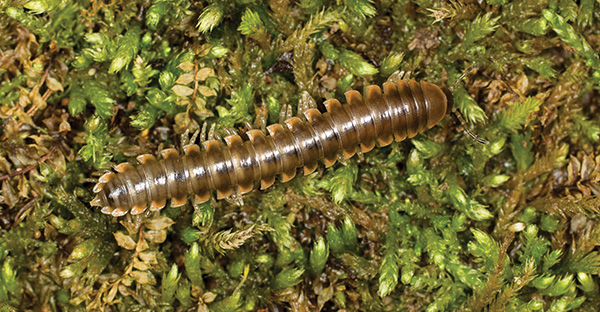 Photo by Derek Hennen
Field zoologist Derek Hennen discovered a new location last year for a rare millipede that was new to science just a few years ago – and named after his wife.
Along with Jackson Means and Paul Marek at Virginia Tech, Hennen worked to describe the new species in 2022: Maple Flats twisted-claw millipede (Nannaria marianae). First found at Maple Flats Ponds, it was named after Hennen’s wife, Marian.
The discovery in 2025 was the fourth known location of the species, which is restricted to the base of Kelley Mountain and the Big Levels area in southeast Augusta County. This species, like others in its genus,is soil-dwelling and lives under logs and leaf litter in forests. Males have enlarged and twisted claws on their anterior legs. Adults are most active in the spring and the fall, but they are difficult to find due to their camouflaging color pattern of brown to black with light orange spots.
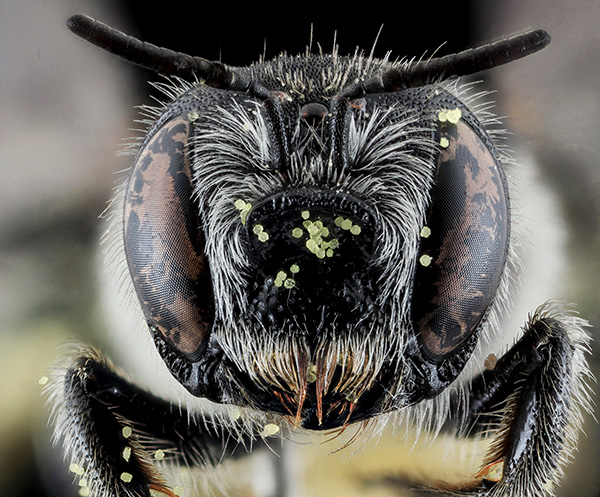
Lead field zoologist Ellison Orcutt recently discovered a cactus wood-borer bee (Lithurgopsis gibbosa) for the first time in Virginia, in the City of Suffolk. The find at South Quay Sandhills Natural Area Preserve marked the northern-most record in the eastern United States for the bee, which is also found in the south, west to Texas and Oklahoma.
A pollen specialist on prickly-pear cactus (Opuntia spp.) plants, also native to Virginia, the bee appears to be restricted to habitats with deep sandy soils. This species will be added to the rare animal list as part of a future update.
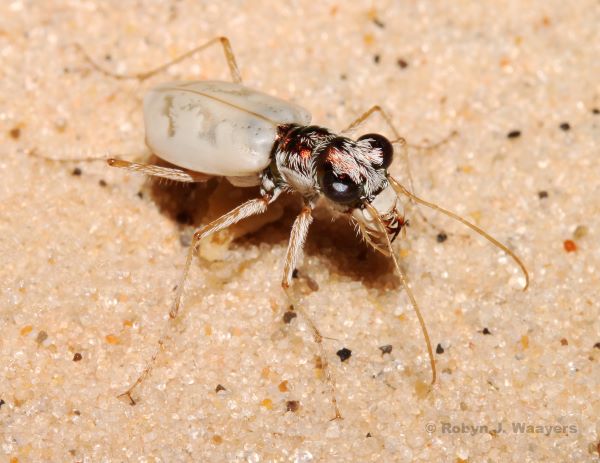 Photo by Robyn J. Waayers
For the first time in 27 years, an adult ghost tiger beetle (Ellipsoptera lepida) was found in Virginia by field zoologist Andrew Rapp.
The discovery in the dunes at False Cape State Park in Virginia Beach last July also marked the first time the state rare species had ever been seen in the city.
These beetles live in the deep sand of tall, bowl-like dunes along the mid-Atlantic coast.
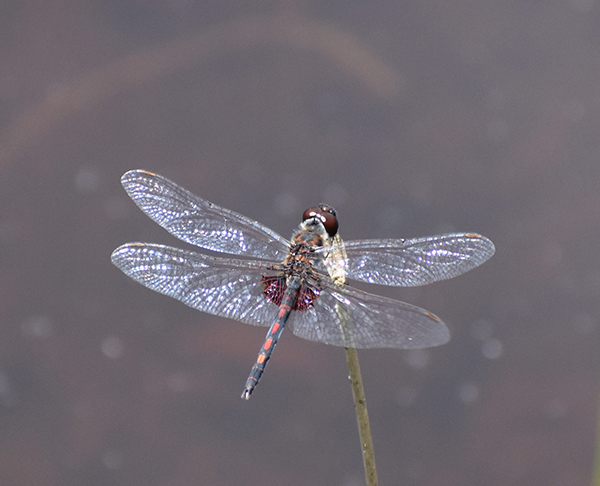 Photo by Andrew Rapp
The ornate pennant (Celithemis ornata), a rare pond- breeding dragonfly more common further south in the U.S., had previously been documented in only two counties in Virginia,Charles City and Sussex.
In 2025, Rapp discovered multiple individuals, including a mated pair, on a pond at Fort A.P. Hill in Caroline County.
 Photo by Andrew Rapp
King’s hairstreak (Satyrium kingi) is a state rare butterfly whose host plant is common sweetleaf or horse-sugar (Symplocos tinctoria).
One population had been documented at a natural area preserve in Southeast Virginia, but had not been spotted since 2012.
Zoology staff conducted surveys for the butterfly in 2025 and found that a healthy population remains. The rediscovery will help inform the management of the preserve, balancing the needs of species that are fire-dependent with others that are not.
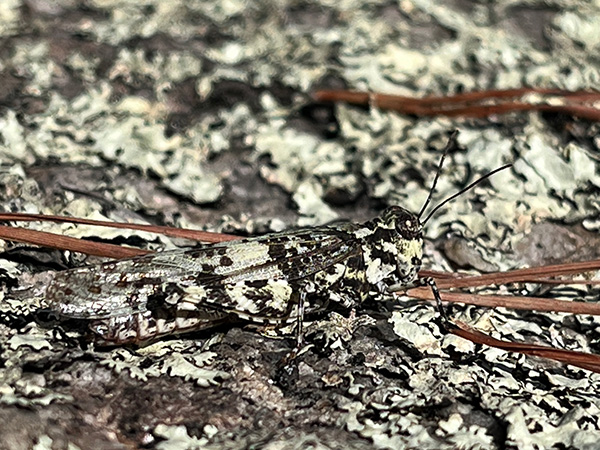 Photo by Gemma Milly
A globally rare lichen grasshopper (Trimerotropis saxatilis), such a master at camouflage that it is practically invisible, was recently discovered in Virginia for the first time in state history.
Found in the flatrocks and rocky glades of the southeastern and midwestern United States, the significant discovery of this band-winged grasshopper expands the species’ known global range.
What makes the find even more unusual is that the biologist who spotted it was a botanist surveying Virginia’s piedmont granitic flatrocks for rare plants, not animals. Gemma Milly was familiar with the lichen grasshopper from her previous experience further south in Georgia.
NOTE:Vegetation ecologists, botanists and zoologists in the Virginia Natural Heritage Program identify species, often in the field, to continually update the state’s comprehensive data system. Observations reported through community science efforts such as iNaturalist do not necessarily overlap with the official state records. Do you think you’ve spotted a rare species? Fill out the rare species sighting form here: https://www.dcr.virginia.gov/natural-heritage/rare-species-sighting
Ellison Orcutt contributed to this blog post.
Categories
Conservation | Natural Heritage | Nature