Department of Conservation and Recreation
Conserve. Protect. Enjoy.
Department of Conservation and Recreation



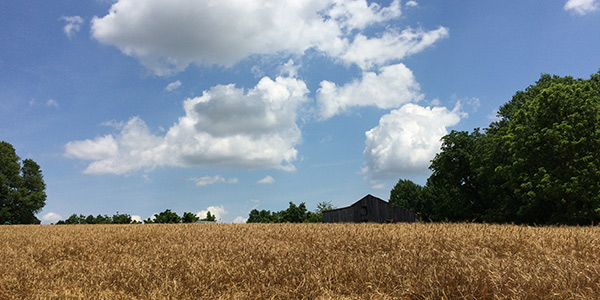
A Virginia Resource Management Plan (RMP) is a comprehensive conservation plan that includes proven agricultural best management practices to ensure the farm is meeting a conservation farming standard. A farmer's decision to have an RMP written, or to implement the plan, is completely voluntary. The plans are written by certified RMP developers and are specific to the farm operation. The RMP will address onsite erosion issues, including measures to protect perennial streams, and include recommendations for nutrient management. The RMP provides a list of agricultural BMPs for the farmer to implement.
Once all required BMPs are implemented, the RMP can be certified. In addition to the environmental benefit to the community, RMP certification means several things for the farmer, including “certainty” that they are considered environmentally compliant. Should newer, more stringent state regulations related to the Chesapeake Bay or local stream TMDLs be adopted, the certified RMP farm operation is considered already to comply with nutrient, sediment and water quality standards. The certificate is valid for nine years provided the farmer continues to implement the RMP.
In 2011, the Virginia General Assembly passed House Bill 1830 (Chapter 781 of the 2011 Virginia Acts of Assembly), which allowed for the creation of the RMP program. Representatives from agricultural commodity groups, conservation organizations, and state and federal agencies developed the RMP regulations. The Virginia Soil and Water Conservation Board approved the regulations in 2013. The effective date of the regulations is July 1, 2014.
Find background information on the development of the regulations.
A farm owner or operator can choose to have an RMP on the whole farm, a tract or just one field. RMPs can be developed for crop, hay or pasture land uses. All RMPs must contain a nutrient management plan and a soil conservation plan to reduce soil loss to “T”. Crop and hay land require a 35-foot forested or vegetative buffer adjacent to perennial streams. Pasture fields must have livestock excluded from perennial streams, hardened stream crossings and alternative watering systems.
The process for an operation to become certified as having implemented a resource management plan is depicted below.

Assessment – A certified RMP developer visits the operation, meets with the farmer, evaluates the land and practices in place, and begins developing options to meet the requirements.

Plan Development – The certified RMP developer meets with the farmer and discusses options to meet the requirements. Once the farmer agrees to the particular BMP(s) and a schedule for implementation, the RMP may be submitted to the review authority (the local soil and water conservation district or DCR) for review and approval.

Plan Implementation – Once the approved plan has been fully implemented, the farmer may request that the review authority visit the farm to verify implementation. A certificate of RMP implementation is issued once the review authority determines full implementation.

Verification – Continued verification visits are conducted every few years to ensure the continued proper functioning and maintenance of the BMPs.

Certification – A certificate of RMP implementation is issued once the review authority verifies implementation. “Certainty” begins at the date of issuance of the certificate. Continued verification visits are conducted at least once every three years throughout the nine-year certainty period to ensure the continued proper functioning and maintenance of all required BMPs.
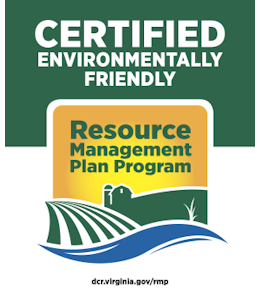
Certified Environmentally Friendly RMP Signs - RMP farm signs bring recognition to those who have become certified as implementing an RMP. Qualified participants interested in a sign should contact Barbara McGarry, 804-371-0297, barbara.mcgarry@dcr.virginia.gov.
Contact a certified RMP developer or your local soil and water conservation district to discuss your interest in an RMP.
Funding is available to pay for the development of resource management plans. Additionally, cost-share funding is available for most of the BMPs needed to meet RMP requirements.
Contact DCR's Barbara McGarry, barbara.mcgarry@dcr.virginia.gov, 804-371-0297.
View this page for Links and Resources for Resource Management Planning.
Read this blog Farm smarter with a Resource Management Plan