Department of Conservation and Recreation
Conserve. Protect. Enjoy.
Department of Conservation and Recreation



The Virginia Land Conservation Foundation Board of Trustees is providing an opportunity for public comments on the proposed FY27 Grant Manual. Anyone wishing to submit written comments for the public comment file may do so through the Virginia Town Hall.
To be considered, comments must be received by 11:59 p.m. on May 11, 2026, the last day of the public comment period.
The full board will meet on June 9, 2026, to open the FY27 grant round.
View the FY25 VLCF Annual Report.
The Board met on Nov. 3, 2025, to award the FY26 VLCF grant round. The Board also adopted this resolution to establish protocol to approve changes of scope for previously awarded grants.
See the list of awarded applications.
Read the press release.
Applications for the grant round were accepted through Aug. 12, 2025. Learn more about the application process, requirements, and scoring in the FY26 VLCF Grant Manual.
A total of $15,810,418 was available for grant funding as allocated in the following five categories:
| Farmland Preservation | $2,550,000 |
| Forestland Preservation | $3,929,536 |
| Historic Area Preservation | $2,726,963 |
| Natural Area Preservation | $3,088,235 |
| Open Spaces and Parks | $3,515,684 |
To get a preview of the application for each of the five categories on the WebGrants Management Portal, view the PDFs below:
| Farmland Preservation |
| Forestland Preservation |
| Historic Area Preservation |
| Natural Area Preservation |
| Open Spaces and Parks |
A virtual Grant Workshop was held on Tuesday, June 17, 2025, to explain the grant process and different categories.
The presentations for each category, as well as an overview, are available here:

In 1999, the General Assembly and governor restructured the Virginia Land Conservation Foundation to fund protection of:
State agencies, local governments, other public bodies, state and federally-recognized Indian Tribes and nonprofit land trusts are eligible to receive matching grants from the foundation to purchase land or conservation easements.
The Virginia Land Conservation Fund receives funding from the state’s annual budget. The Virginia Department of Conservation and Recreation provides staff and administrative support. An interagency taskforce reviews and recommends grant applications to the Virginia Land Conservation Foundation. Grant awards are based on applications for 50% or less of total project costs (state agencies may receive 100%) pursuant to specific criteria defined in each category.
The VLCF Board and DCR submit an annual report of the Virginia Land Conservation Foundation to the governor and General Assembly. This report summarizes VLCF Board activities for the two-year window, provides information on funded projects, describes how funds are allocated, and tracks the amount of land conserved in the commonwealth. The last report was issued in February 2026.
Since the beginning of the program in 2000, VLCF has awarded 356 grants totaling more than $118 million to protect more than 156,000 acres across the commonwealth. To learn about the projects that have been funded, search the interactive map below.
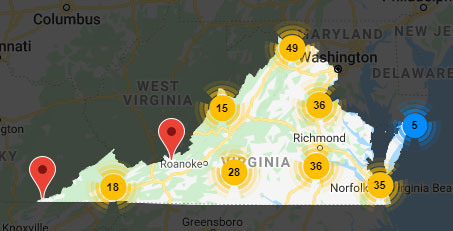

The VLCF board met on Nov. 21, 2024, to award $14.4 million in funding to 28 projects across Virginia. Please see the FY25 VLCF Grant Round press release and list of awarded projects. Download the meeting materials.
Learn more about the application process, requirements, and scoring in the FY25 VLCF Grant Manual.
A virtual Grant Workshop was held to explain the grant process and different categories.
View the video of the workshop.
If you have any questions, please contact Suzan Bulbulkaya at Suzan.Bulbulkaya@dcr.virginia.gov.
Visit our State and Federal Grants page to learn more about other land conservation grant opportunities.
A subcommittee of the VLCF Board met on April 17, 2025, to discuss the upcoming grant round and the FY26 grant manual.
An agenda for this meeting can be found here.
Following April's subcommittee meeting the board provided a three-week public comment period to seek input on the proposed FY26 Grant Manual.
A subcommittee of the VLCF Board met virtually on March 26, 2021.
At its Oct. 27, 2015, meeting, the VLCF Board of Trustees adopted guidance for resolving disputes related to the interpretation or administration of conservation easements in accordance with ss10.1-1021.2 of the Code of Virginia. This is the final guidance document.
In 2009, the VLCF Board amended the Land Preservation Tax Credit (LPTC) Conservation Value Review Criteria to verify the conservation value of donated land or conservation easements that result in tax credit applications of $1 million or more.
Board members can find information regarding FOIA, travel regulations, open meetings, and more on the Resources for VLCF board members page.
If you have questions, email Suzan Bulbulkaya, Land Conservation Manager, at suzan.bulbulkaya@dcr.virginia.gov or call 804-371-5218.