Department of Conservation and Recreation
Conserve. Protect. Enjoy.
Department of Conservation and Recreation



The Preserve System
The Virginia Natural Area Preserves System was established in the late 1980's to protect some of the most significant natural areas in the Commonwealth. A site becomes a component of the preserve system once it is dedicated as a natural area preserve by the Director of the Department of Conservation &
Recreation. Natural area dedication works in much the same way as a conservation easement by placing legally binding restrictions on future activities on a property. The Natural Area Preserve System includes examples of some of the rarest natural communities and rare species habitats in Virginia.
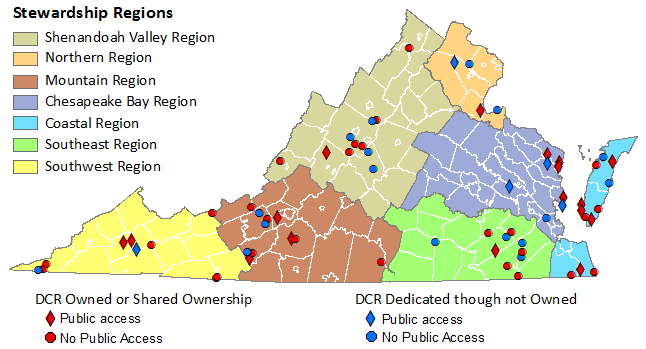
This system now includes sixty six dedicated natural areas totaling 61,153 acres.
To learn more about DCR's approach for managing Virginia's Natural Area Preserves, see the NAP Management Guidelines.
Most of the preserves are owned by the Department of Conservation and Recreation, but some are lands owned by other state and local government agencies, universities, private citizens and private conservation organizations.
Each natural area preserve is managed primarily for the benefit of the rare plants, animals and natural communities found there. Twenty-two preserves feature low-intensity public access facilities such as trails and parking. These are open year-round during daylight hours but may be subject to temporary closure to protect sensitive species or during some management activities, such as prescribed burning. Access to other preserves is restricted but generally may be arranged by contacting the site owner or manager. Read and/or download a brochure about Virginia's Natural Area Preserves with public access. Find out about research opportunities on Natural Area Preserves .
Visiting a natural area preserve can be a wonderful and unique experience. A key to having a good visit is being prepared for the adventure. Most natural area preserves have no restroom facilities. Three preserves Buffalo Mountain, Crow's Nest and Pinnacle have only a port-a-jon. Likewise, preserves do not have trash cans, access to drinking water, or on-site staff. You'll need to plan your trip around bathroom breaks, practice "leave no trace" by packing out all trash, bring plenty of water, keep all dogs on a leash at all times and carry a cell phone for emergencies. Last, preserve parking lots are small, ranging from four to 20 spots. A full parking lot indicates the preserve has reached capacity. If you arrive and the lot is full, please return at another time. Do not park illegally on adjacent private property, along the access road, within a public road right-of-way, or in any other non-designated location.
The sandy shorelines of Virginia's coastal natural area preserves are not recreational beaches. Rather, these shorelines are managed primarily to provide habitat for rare species of plants and animals, plus critical nesting areas for shorebirds. Some preserves with sandy shorelines are open to the public and available for walking, photography, wildlife watching and birding. However, other shoreline areas are closed due to the presence of protected species and nesting birds. Check the preserve web page before visiting.
The Commonwealth of Virginia's natural area preserves, state forests, state parks and wildlife management areas offer hundreds of miles of trails designed for people to enjoy (or access) the outdoors. These trails offer the public opportunities to experience and enjoy the state's flora, fauna, cultural resources and scenic beauty. Hiking, angling, boating, hunting, wildlife watching, bicycling and horseback riding are proven contributors to good physical health and mental well-being – part of a healthy lifestyle that reduces illness, obesity and anxiety for all.
Effective March 15, 2011, these trails were opened to wheelchairs, including manual and power wheelchairs, personal mobility assistive scooters, and certain other similar devices designed primarily to assist people with disabilities. Users are encouraged to use caution when selecting trails, as many were designed for foot traffic only. Terrain might make them unsuitable for personal mobility devices. As part of their commitment to making Virginia's public lands places for all to enjoy, the Virginia Departments of Conservation and Recreation, Forestry, and Wildlife Resources are also in the process of evaluating safety concerns and environmental impacts of opening these trails to the use of other power driven mobility devices by individuals with mobility disabilities. Please check this webpage periodically for updates.